
 SEARCH
 LIST YOUR PROPERTY
As the 2026 academic year approaches, the housing market is more dynamic than ever. Many hosts with a spare room are wondering how best to rent it out. At Roomlala, we assist hosts every day who are looking to take the plunge, but often face a crucial question: which type of lease should I choose? Should I opt for a specific 2026 student lease or turn to a standard furnished lease? The answer depends on your goals, your need for flexibility, and the profile of your future tenant. In this detailed article, we will decode the difference between a student lease and a furnished lease for you, to help you make the most appropriate decision for your situation. Whether you are looking to reclaim your room for the summer or ensure continuous rental income throughout the year, we explain everything you need to know about the legislation currently in effect this year.
Understanding the difference between a student lease and a furnished lease
Choosing the right rental contract is the first fundamental step for any host wishing to rent out a homestay. In France, furnished rentals offer two main options that have distinct characteristics in terms of duration and renewal. At Roomlala, we find that understanding these nuances allows our hosts to rent with peace of mind and avoid unpleasant surprises at the end of the academic year.
Read also: Student housing shortage in 2026: Homestay as a key solution for the new academic year, Housing crisis in Portugal: 2026 tax incentives for room rentals and Rental fraud in Spain: The new 2026 rules that secure long-term shared housing
The 9-month student lease: summer flexibility
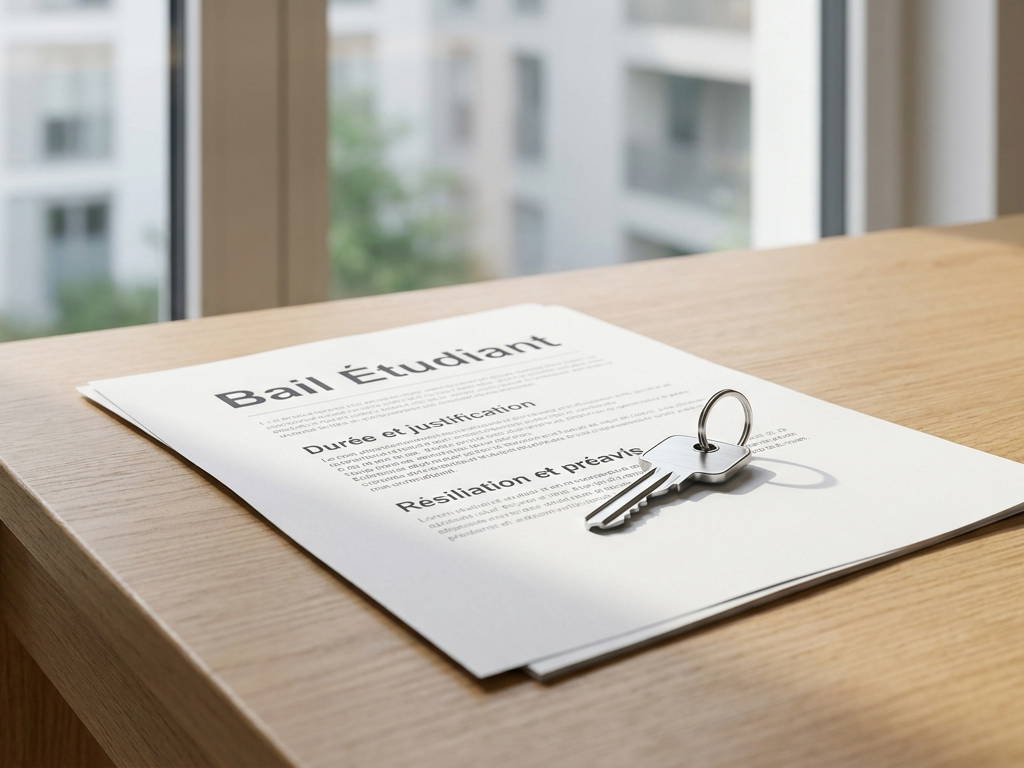
The student lease is a furnished rental contract specifically designed to fit the academic year. Its main feature is its fixed 9-month duration. Unlike other contracts, it does not include automatic renewal. This means that at the end of the 9 months, the contract terminates automatically. For you, as a host, this is an exceptional guarantee of flexibility: you regain the use of your room for the summer period without having to carry out complex procedures or justify a reason for termination.
To use this student room rental contract, the legislation is strict: you must imperatively require proof of your future tenant's student status at the time of signing. This can be a valid student ID card for the 2026-2027 year or a certificate of enrollment. Without this document, the contract could be reclassified as a standard one-year furnished lease, causing you to lose the benefit of automatic termination after 9 months.
Concrete example: Take the case of Marie, a Roomlala host in Lyon. She rents out her son's room after he left to study abroad. By signing a 9-month student lease from September to May with a young undergraduate student, she ensures she can reclaim her room from June to August. This allows her to host her family during the summer holidays, or even offer her room for very short-term rentals to summer tourists, thus optimizing her income while keeping control of her home.
The standard one-year furnished lease: stability above all
The standard furnished lease, meanwhile, is concluded for a minimum duration of one year. Its main difference lies in its automatic renewal mechanism: if neither party expresses a desire to terminate, the contract is automatically renewed for another year. This type of contract is not reserved for students; it can be signed with any tenant profile (young professionals, interns, employees on the move).
This contract is ideal if you are looking for rental stability and do not want your room to be unoccupied during the summer months. Many students, especially those in Master's programs, apprenticeships, or those planning to do a summer internship in the same city, actually prefer this type of lease so they don't have to move all their belongings in June.
Use case: Paul, a Parisian host, prefers peace of mind. He signed a standard furnished lease with Sophie, a student at a business school who is doing a two-year apprenticeship. Thanks to this contract, Paul does not have to search for a new tenant every September. The lease renews automatically, ensuring regular income over 12 continuous months, with no summer interruption.
Renting a student room: Legislation and essential rules in 2026
Renting a furnished room is not something to be improvised. In 2026, the legal framework has tightened, particularly on environmental and comfort issues. At Roomlala, we make it a point of honor to inform our hosts of the latest legislative changes to ensure rentals are perfectly compliant. Here are the two major points of vigilance for this year.
Energy compliance and the 2026 DPE
Regulations related to the Energy Performance Diagnosis (DPE) are arguably the hottest topic for hosts in 2026. Energy decency rules apply strictly to furnished rentals, including for homestays. Since January 1, 2025, the Climate and Resilience Law formally prohibits signing a new lease (or renewing an existing one via automatic renewal) for a home rated G on the DPE. These homes are now considered energetically indecent.
If you are planning to offer a student room rental contract for the start of the 2026 academic year, you must absolutely ensure that your overall home displays at least an F rating (knowing that the ban for class F is scheduled for 2028). This measure aims to protect tenants against energy poverty and excessive heating bills, while encouraging the renovation of the real estate stock.
Concrete example: If your apartment is rated G, you can no longer legally rent out your guest room. Before publishing your listing on Roomlala, you will need to carry out insulation work (such as changing windows or insulating the attic) to reach at least class F. Government aid, such as MaPrimeRénov', is still available in 2026 to support you in these essential steps.
Mandatory equipment for a student room rental contract
For your contract to be legally recognized as a furnished lease (whether it is 9 months or one year), the room and shared spaces must contain a minimum level of equipment. The law sets a strict list of 11 mandatory items. If one of these elements is missing, the tenant could request the reclassification of the lease into an unfurnished rental, which would drastically change the rules (3-year lease, different notice periods, less advantageous taxation).
Your tenant must be able to live, sleep, and eat there comfortably upon arrival, bringing only their personal effects. The list includes: complete bedding with a duvet or blanket, blackout blinds or curtains in the room, stovetops, an oven or microwave, a refrigerator with a freezer compartment, tableware, kitchen utensils, a table and chairs, storage shelves, light fixtures, and household maintenance equipment adapted to the home.
Use case: When preparing the room, don't just provide a bed and a desk. Ensure the student has free access to your equipped kitchen (which must contain the mentioned elements) and provide them with dedicated storage space in the refrigerator and cupboards. At Roomlala, we advise you to create a precise, photographic inventory of these items during the move-in inspection to protect yourself.
End of contract, notice, and security deposit: Everyone's rights
Managing the end of a contract and financial guarantees is often a source of worry for hosts. However, the legislation governing the 2026 student lease and the standard furnished lease is very clear and balanced. It protects both the tenant's flexibility and the host's financial security.
On the tenant's side, the rule is very flexible, regardless of the contract chosen. The student has the option to leave the home at any time, simply by respecting a one-month notice period. They must notify you of their departure by registered letter with acknowledgment of receipt, by a bailiff's act, or by handing it over in person against a signature. This flexibility is crucial for students whose plans may change during the year (change of major, unexpected internship in another city).
On the host's side, the situation differs significantly depending on the lease. With the 9-month student lease, you are completely exempt from providing notice: the contract terminates on its own on the expected date. On the other hand, to terminate a standard one-year furnished lease, you must respect a 3-month notice period before the contract's expiry date, and above all, justify a legitimate and serious reason (such as selling the home, reclaiming it to house a relative, or serious misconduct by the tenant). You cannot, therefore, terminate a one-year lease simply because you changed your mind.
Regarding the security deposit, the rule is the same for both types of furnished leases. The law caps this amount at two months' rent excluding charges. This sum, which you collect upon signing the lease, serves as your security in case of damage noted during the move-out inspection or unpaid rent. Concrete example: For a room rented for €400 per month including €50 in charges (i.e., €350 in base rent), you can request a maximum security deposit of €700. At Roomlala, we recommend that you detail the flat-rate charges in the contract to avoid any confusion when returning this deposit.
Taxation and benefits: Why take the plunge with Roomlala?
Beyond the legal aspect, renting out a room in your home offers significant tax advantages that are worth highlighting. Whether you opt for the student lease or the standard furnished lease, you fall under the very advantageous status of Non-Professional Furnished Rental (LMNP). This status is a real lever for optimizing your rental income.
Income generated from renting your room is not considered standard property income but is taxed in the category of Industrial and Commercial Profits (BIC). This regime offers you two possibilities: the micro-BIC regime or the actual regime. The micro-BIC regime is the simplest and most favored by our hosts: it allows you to benefit from a flat-rate deduction of 50% on your rental income. Concretely, you will only pay taxes on half of the rent collected!
Furthermore, under certain strict conditions regarding rent caps set by tax authorities, renting out a portion of your primary residence can even be completely exempt from income tax. This is an exceptional financial opportunity to supplement your income in the face of inflation in 2026.
Concrete example: If you collect €4,000 in rent over the academic year with a 9-month lease, by choosing the micro-BIC regime, only €2,000 will be added to your taxable income. At Roomlala, we facilitate all your procedures: from connecting you with students whose identity has been verified, to securing payments. You can thus focus on what matters: offering a warm, human welcome to a student, all while enjoying an extremely secure legal and fiscal framework. Don't wait any longer, start preparing for the 2026 academic year today!


There are no comments yet.
Leave a comment
You must be logged in to post a comment.