
 SEARCH
 LIST YOUR PROPERTY
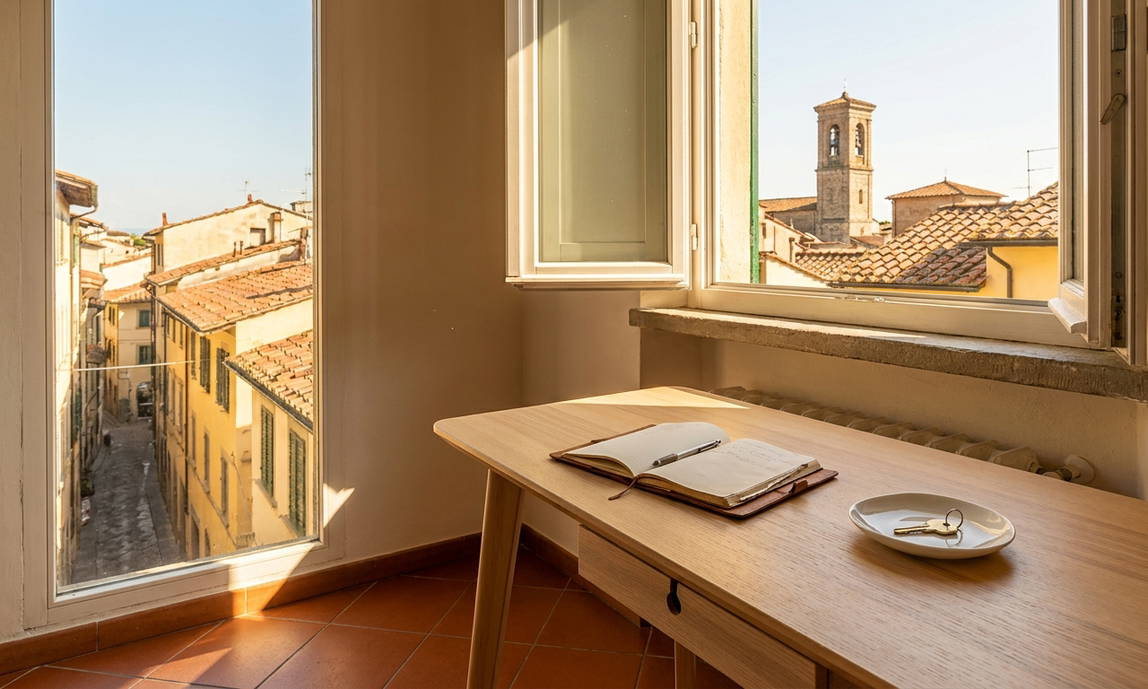
In Italy, the student housing crisis is a palpable reality affecting many families. Every year, thousands of young people struggle to find affordable accommodation in the country's major university cities, from Milan to Rome, through to Bologna or Florence. Facing this shortage of housing, you, as a host with a spare room in your primary residence, have a real ace up your sleeve. At Roomlala, we see the extremely positive impact of homestays on a daily basis. Not only are you offering a secure roof to a young person building their future, but the Italian state rewards you generously thanks to a particularly attractive tax scheme: the 2026 Cedolare Secca. This regime, far from being a simple tax loophole, stands as the reference solution for optimizing your rental income while protecting yourself from traditional administrative burdens. Together, we will decode how this tax regime can transform your unoccupied room into a stable, low-taxed, and perfectly legal source of income.
What is the 2026 Cedolare Secca for hosts in Italy?
The traditional Italian tax system, based on IRPEF (Personal Income Tax), can prove particularly heavy for hosts. Rental income is added to your other earnings (salaries, pensions) and is taxed according to a progressive scale that can quickly reach heights, sometimes exceeding 43% for the top brackets. It is precisely to lighten this pressure and encourage the placing of properties on the market that the government has made the Cedolare Secca permanent in 2026. This is an optional tax regime that purely and simply replaces IRPEF, local surcharges (municipal and regional additions), as well as registration and stamp duties with a single flat-rate tax.
Read also: New CIN regulations in Italy: Why hosts are turning to shared housing in 2026, 2026 university start in Italy: Everything you need to know about the student contract (Contratto per Studenti) and LMNP reform and 2026 DPE regulations: Why homestays are becoming a haven for hosts
The great strength of the 2026 Cedolare Secca lies in its flexibility. This regime applies perfectly to the partial rental of a property. If you decide to rent out a student room within your own primary residence, you are fully eligible for this scheme, provided you act as a private individual (persona fisica) outside of any commercial or business activity. At Roomlala, we strongly encourage our hosts to opt for this solution, which guarantees unmatched peace of mind. You know exactly what percentage of your rental income will be owed to the state, without any unpleasant surprises at the end of the fiscal year.
By opting for this regime, you are choosing simplicity. No more complex depreciation calculations or various deductions that often require the costly intervention of an accountant. The Cedolare Secca is calculated directly on 100% of the gross rent received. It is a clear and transparent pact between you and the Italian tax authorities, designed to encourage you to open your doors to students who are in dire need.
A flat-rate tax that simplifies the lives of hosts
Within the framework of the free market (canone libero), the standard rate of the Cedolare Secca is set at 21%. This rate is already extremely competitive compared to traditional IRPEF for the majority of Italian taxpayers. However, the real opportunity in 2026 lies in the reduced rate of 10%, specifically designed for rentals meeting precise social and geographic criteria, such as student housing. This 10% rate is an exceptional boon for Italian rental taxation.
Let's take a concrete example to illustrate this advantage. If you receive 4,000 euros in annual rental income by renting out your room, a standard IRPEF assessment (with an average marginal bracket of 35%) would cost you about 1,400 euros in taxes, excluding local taxes. With the Cedolare Secca at the reduced rate of 10%, your tax drops to just 400 euros. That is a net saving of 1,000 euros per year that stays directly in your pocket.
This flat-rate mechanism also protects your other income. Since rents subject to the Cedolare Secca are not added to your total income for the calculation of IRPEF, they do not risk pushing you into a higher tax bracket. You thus retain the entirety of any social benefits or tax deductions linked to your personal situation.
Eligibility requirements for renting a homestay room
To benefit from the Cedolare Secca, several strict conditions must be met. First of all, as mentioned previously, the lessor must be a private individual. If the property belongs to a company or if you rent as part of a professional activity (Bed & Breakfast with a VAT number, for example), this regime is closed to you. Shared housing between individuals in Italy is therefore the ideal playing field for this device.
An unavoidable legal condition of the Cedolare Secca is the formal waiver of any rent increase or indexation for the entire duration of the tax option. In Italy, rents are traditionally indexed to inflation via the ISTAT index. By choosing the flat-rate tax, you agree to freeze the rent amount. This waiver must be explicitly notified to the tenant, generally through a specific clause included in the rental contract.
Although waiving ISTAT indexation might seem like a drawback during periods of inflation, the math is simple. The tax savings achieved (moving from 21% or IRPEF to 10%) easily compensate for the loss of a few tens of euros linked to the lack of annual rent indexation. It is a win-win compromise: the student tenant benefits from a stable rent, and you, the host, maximize your net yield.
How to benefit from the 10% reduced rate for a student room?
The 10% reduced rate is the holy grail of Italian host taxes. However, it does not apply automatically to all rentals. To claim it, your contract must fall within the framework of the regulated market (canone concordato). The Italian government uses this tax lever to regulate prices in areas where demand for housing is much stronger than supply, thus protecting vulnerable populations such as students.
To apply this rate to renting a room, the property must imperatively be located in a municipality with high housing pressure (comune ad alta tensione abitativa), in a provincial capital, or in a municipality bordering large metropolitan areas. Fortunately, almost all Italian university cities (Milan, Rome, Turin, Padua, Pisa, etc.) appear on this official list. It is therefore an opportunity perfectly aligned with the desire to rent to a student.
At Roomlala, we support you in understanding these mechanisms. We know that profitability is essential to reassure you and encourage you to take the step of cohabitation. The 10% rate transforms a simple unoccupied room into a true financial asset, while giving you the satisfaction of participating in the national solidarity effort in the face of the student housing crisis.
The student contract: specific and advantageous rules
Italian property law provides for a specific type of lease for university students (contratto di locazione per studenti universitari). This contract is extremely advantageous for hosts who wish to rent a room on a temporary basis without committing to very long durations like the traditional 4+4 year lease.
The legal duration of this student contract is between 6 months and 36 months. This flexibility is ideal for adapting to the university calendar. You can, for example, rent your room from September to June, regain exclusive use of your home during the summer to host your family, then sign a new contract for the next school year. This flexibility is one of the major arguments that convince our Roomlala hosts.
Furthermore, this type of contract strictly governs termination conditions. While the student can, under certain conditions of serious reasons, provide notice, the host is guaranteed stable occupancy for the agreed duration, supported by parental guarantees in the majority of cases. It is undeniable security for your income.
Regulated rent (Canone Concordato) in detail
The sine qua non condition for benefiting from the 10% rate is compliance with the 'canone concordato'. This is rent control defined locally by territorial agreements (accordi territoriali) between hosts' unions and tenants' associations. These agreements set a minimum and maximum price per square meter based on the area of the city and the characteristics of the property (presence of an elevator, condition of furniture, etc.).
Take the case of Giulia, who owns a large apartment in Bologna. On the free market, she could rent her room for 500 euros per month and pay 21% in Cedolare Secca (or more in IRPEF). Her net income would be 395 euros. By opting for the regulated rent student contract, the local cap imposes a maximum rent of 430 euros. However, thanks to the 10% reduced rate, her tax is now only 43 euros. Her net income increases to 387 euros. The financial difference is minimal, but her property is rented immediately, she is helping a student, and she benefits from additional deductions on her local property tax (IMU).
It is crucial to have the calculation of this regulated rent validated by an association that is a signatory to the territorial agreement (attestazione di rispondenza). This attestation proves to the Agenzia delle Entrate that your rent respects the legal caps, thus permanently securing your right to the 10% rate.
Rental taxation in Italy: The pitfalls to avoid at all costs in 2026
The year 2026 marks a decisive turning point in property taxation in Italy. The government has decided to crack down on the proliferation of short-term tourist rentals (like Airbnb) that empty city centers of their year-round inhabitants. As a host, it is fundamental to fully understand these new rules to avoid falling into costly tax traps and to make the right strategic choice.
The temptation of nightly tourist rentals may seem great, but 2026 legislation has significantly hardened the conditions. The State's objective is clear: redirect hosts toward traditional residential and student rentals. At Roomlala, we have always defended medium and long-term homestays, which foster human connection and stability.
It is therefore essential to correctly qualify your contract. A room rented to a student for 6 months or a year does not follow the same rules at all as a room rented to passing tourists. Confusion between these two regimes could cost you very dearly in the event of an audit by the tax authorities.
Do not confuse student leases with tourist rentals
The new features of the 2026 Cedolare Secca are particularly punitive for short-term rentals (affitti brevi). If you rent out more than one property for tourist rentals, the tax rate automatically climbs to 26% from the second property. Worse still, starting from the third property rented on a short-term basis, the State considers it to be an entrepreneurial activity. You are then obliged to open a VAT number (Partita IVA), with all the accounting and social charges that this implies.
In contrast, student homestays remain completely protected from these punitive measures. By renting your room to a student for a duration of 6 to 36 months, you remain serenely within the framework of private asset management. You retain your right to the 10% rate (if rent is regulated) or 21% (free market), without any risk of being reclassified as a professional, even if you rent out several rooms in your house.
This is a compelling argument to reassure you. The choice of student rental is today the choice of tax security and administrative peace of mind in Italy.
Risks in case of non-compliance with regulated rent
The Agenzia delle Entrate (Italian tax authority) is particularly vigilant regarding the application of the 10% reduced rate. The major point of vigilance concerns strict compliance with the cap imposed by the canone concordato. Some hosts are tempted to declare a regulated rent on the contract to obtain the 10%, while asking for a supplement in cash from the tenant. This is an illegal and extremely risky practice.
In the event of an audit, if the administration proves that the real rent exceeds the caps of the territorial agreement, the sanction is immediate. The revocation of the 10% rate is pronounced retroactively. The host suffers an automatic return to the standard 21% rate (or IRPEF if it proves more penalizing), accompanied by heavy late payment penalties and surcharges.
Furthermore, the student tenant has the right to take legal action to demand the reimbursement of sums paid beyond the legal cap. To sleep soundly, total transparency is required. Respect the caps, obtain your certificate of compliance, and enjoy your legally optimized income in peace.
Administrative steps: How to declare your tax option?
Setting up the Cedolare Secca is a declarative process that requires a minimum of rigor, but remains very accessible. The option for this tax regime is not automatic. It must imperatively be declared when registering the rental contract with the Agenzia delle Entrate. This step is a mandatory procedure in Italy for any lease lasting longer than 30 days.
To do this, you must use the RLI model (Registrazione Locazioni Immobiliari). This form allows you to register the contract, pay any applicable taxes (which are canceled if you choose the Cedolare Secca), and notify your tax choice. The declaration can be made online via the Fisconline portal of the Agenzia delle Entrate, or physically in an administration office.
It is crucial to respect the legal deadlines. You have 30 calendar days from the date of contract signing (or its effective date if it is earlier) to proceed with this registration. This same 30-day period applies in the event of an extension of an existing contract. If you forget to check the Cedolare Secca option within this timeframe, you will automatically be subject to the IRPEF regime for the current year. At Roomlala, we help you find the ideal tenant in complete security; all you have to do is finalize these few administrative steps.
- Draft and sign a student contract (6 to 36 months) while respecting the canone concordato caps if you are aiming for 10%.
- Imperatively insert the ISTAT indexation waiver clause into the contract.
- Complete the RLI form (online or paper) within 30 days following signing.
- Explicitly check the box opting for the Cedolare Secca on the RLI form.
- Carefully keep the registration receipt provided by the Agenzia delle Entrate.
By following these simple steps, you transform the rental of your room into an enriching human experience and a very advantageous financial one. The 2026 Cedolare Secca is the ideal boost to encourage Italian hosts to open their doors and actively participate in resolving the student housing crisis. Get started today and post your listing on Roomlala!



There are no comments yet.
Leave a comment
You must be logged in to post a comment.