
 SEARCH
 LIST YOUR PROPERTY
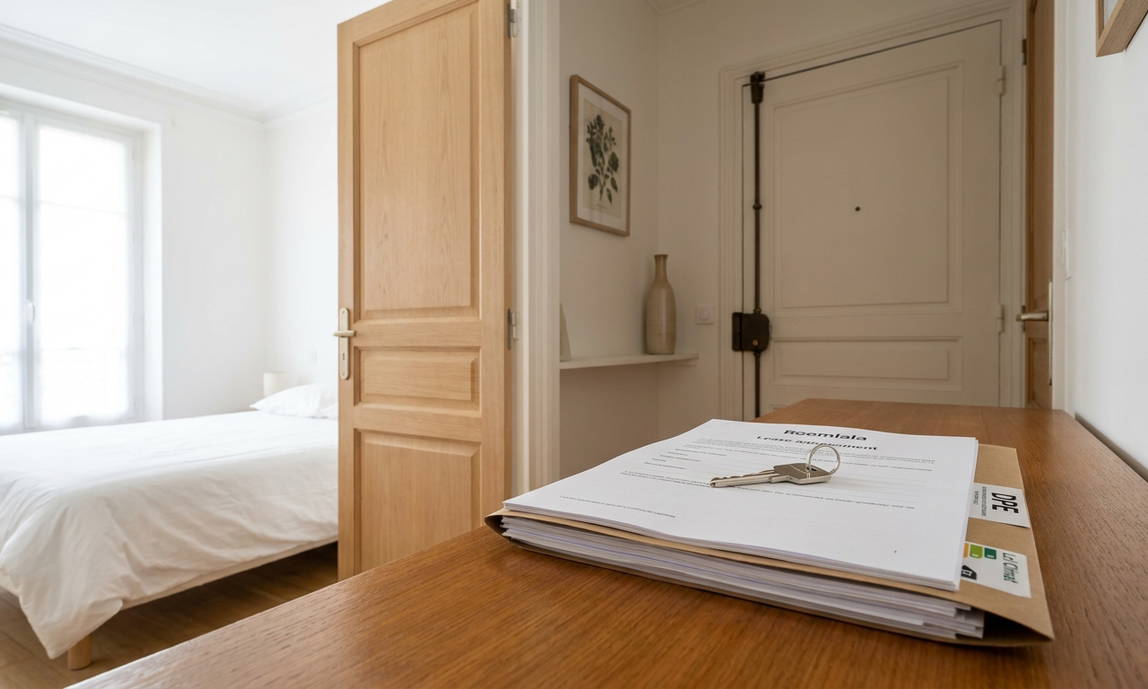
Since January 1st, 2025, the French rental property market has been going through an unprecedented period of turbulence. With the entry into force of the Climate and Resilience Law, the renting out of entire homes classified as G is strictly prohibited for principal residence leases. This radical measure aims to eradicate what is commonly known as a "thermal sieve" rental. Faced with this situation, many landlords find themselves at an impasse, fearing the upcoming deadlines. At Roomlala, we see the growing concern of our community of hosts every day. Fortunately, with the start of the student academic year approaching, a legal and particularly advantageous alternative is emerging: renting a room in a homestay. But how exactly does the regulation apply to the 2026 energy performance certificate (DPE)? Is this the miracle solution to continue generating rental income without undertaking major energy renovation work? We break down all the legal subtleties of this practice for you so that you can proceed with confidence.
Climate Law and thermal sieves: What changes with the 2026 DPE
To fully understand current issues, it is essential to revisit the foundations of the Climate and Resilience Law. Its objective is clear: to fight against energy poverty by gradually removing the most energy-intensive homes from the rental market. Since the beginning of 2025, it has been formally prohibited to sign a new lease or renew an existing one for an entire home classified as G under the Energy Performance Certificate (DPE) when it constitutes the tenant's principal residence. This prohibition will extend to homes classified as F starting in 2028, further increasing the pressure on landlords. The 2026 DPE therefore marks a pivotal period where energy transition is no longer an option but a strict legal obligation for traditional landlords.
Read also: Rent control 2026: Which new cities are making the move for the start of the school year?, 2026 Mobility Lease: The legal framework for renting out your room with total flexibility and Porta 65 housing assistance in 2026: What young tenants and hosts need to know in Portugal
The concept of a "thermal sieve" rental is now at the heart of all real estate concerns. A home is qualified as a thermal sieve when it shows excessive energy consumption, resulting in exorbitant heating bills for the tenant and significantly degraded living comfort. Public authorities, through the Ministry of Ecological Transition, have implemented this restrictive calendar to force renovations. However, this policy of coercion has significant collateral effects. Many small landlords, lacking the financial means to carry out exterior insulation or completely replace their heating system, prefer to withdraw their property from the market. This creates unprecedented rental tension, particularly in large French university cities.
At Roomlala, we observe that this scarcity of supply directly impacts tenants looking for a roof. This is where the 2026 student rental regulation makes full sense. Students are the first victims of this shortage of small spaces (studios and one-bedroom apartments), which are historically the worst classified in the DPE. Faced with this alarming finding, the law has fortunately provided for differentiated legal frameworks depending on the nature of the rental. It is essential to understand that the drastic rules applying to an apartment rented in its entirety are not fully transferable when it comes to sharing your own living space. It is this fundamental legal nuance that opens up new perspectives for owner-occupiers.
The strict schedule of rental prohibitions
The government calendar leaves no room for doubt. After the rent freeze for thermal sieves (classes F and G) in effect since 2022, the ban on renting out now hits G-rated homes in 2025. In 2028, it will be the turn of homes classified as F, then homes classified as E in 2034. This calendar applies implacably to entire homes rented unfurnished or furnished as a principal residence. For a landlord whose apartment is classified as G today, the year 2026 promises to be a blank year if they do not initiate renovations. They will be unable to sign either a new 9-month student lease or a renewable one-year lease. The penalty for non-compliance is severe: the tenant can demand a rent reduction, or even order the work to be carried out under a court-issued penalty.
The impact on the 2026 student rental regulation
The 2026 student rental regulation is feeling the full impact of these prohibitions. The classic student lease, lasting 9 months, is considered by law to be a principal residence lease. Consequently, it is subject to the same energy decency requirements as a classic lease. If you rent an independent studio classified as G to a student for the start of the 2026 school year, you are acting illegally. The entire home must imperatively justify at least an F rating in 2026 for this type of contract. This is a crucial piece of information that we often remind our users of: the protection of the student tenant takes priority, and the legislator makes no concessions regarding the energy performance of entire homes, even for durations reduced to the academic year.
Renting a homestay room: An exception to the DPE rule?
It is in this tense legal context that renting a homestay room reveals its full potential. The homestay room climate law enjoys a special status, often unknown to the general public. The golden rule to remember is as follows: renting a room within your principal residence is exempt from the need for an individual DPE for the room itself, provided that the surface area of the rented room is less than 14 square metres. In this specific case, it is the global DPE of your principal residence that is valid. You do not need to call in a technician to specifically assess the student's room. This administrative simplification is a real breath of fresh air for hosts.
Furthermore, recent legislative developments have reinforced the appeal of this model. The Le Meur law, enacted in November 2024, has considerably tightened the rules governing tourist furnished rentals (like Airbnb) by applying, in particular, quotas and strict DPE obligations. However, the homestay room totally escapes this strict definition of tourist furnished rentals. By renting a room within your own principal residence, you are not considered an operator of tourist furnished rentals within the meaning of this new law. This means that for short-term rentals, you are exempt from the new rental prohibitions related to the DPE that strike traditional investors. This is a major legal opportunity to generate additional income without being blocked by increasingly punitive local regulations.
At Roomlala, we encourage this practice because it promotes social cohesion and optimizes the use of existing built space. Rather than leaving a room empty, the host makes it available to a tenant, thus participating in the collective effort against the housing crisis. However, it is essential to properly structure your rental project to stay within the bounds of legality. The nature of the rental contract you have your tenant sign will directly determine the energy rules that will apply to your home. This is not a legal loophole, but an intelligent application of the texts in force, designed to protect the host's home while offering a flexible housing solution.
Student lease vs. Short-term rental: What is the difference regarding the DPE?
It is crucial to distinguish the type of lease you offer. As mentioned previously, if you opt for a classic 9-month student lease, the room becomes the student's principal residence. In this scenario, the entire home (your house or apartment) remains subject to energy decency criteria. In 2026, your entire home must therefore not be classified as G. On the other hand, if you opt for short-term rentals (a few weeks, month-by-month outside of a principal residence, or occasional professional stays), you bypass the strict DPE blocks linked to the principal residence.
Here are the major differences to remember according to the type of contract:
- The 9-month student lease: constitutes the principal residence. The entire home is subject to the DPE and must not be classified as G in 2026.
- The mobility lease (1 to 10 months): designed for temporary stays, it offers greater flexibility in the face of the strict prohibitions of the principal residence.
- Short-term rental (tourist or occasional): totally escapes the DPE constraints and the quotas of the Le Meur law, ideal for thermal sieves.
Let's take the example of Sophie, owner of a house classified as G in Lille. She cannot sign a 9-month student lease for the start of the 2026 school year. However, she can certainly rent her room by the month via Roomlala to workers in training or international students on short language stays, because these contracts do not constitute a principal residence under the 1989 law.
Beware of the independent entrance trap
This is one of the major points of vigilance on which we insist at Roomlala. For the room to be legally considered a homestay room, access to this room must compulsorily be through the main entrance of your residence. If you have converted a room on the ground floor or in your garden with an independent entrance door leading directly to the street or the outside, the situation changes radically. In the eyes of the law, this room is reclassified as an entire home (an outbuilding or studio). It immediately loses its protective status as a homestay room and finds itself subject to the strict prohibitions of thermal sieves. If this outbuilding is classified as G, its rental as a principal residence is totally prohibited in 2026. Therefore, ensure that your tenant shares your entrance door and moves through the common areas of your home.
Mandatory decency criteria for a homestay room
While the regulation is more flexible on energy performance for short-term rentals or rooms smaller than 14 m2, it remains uncompromising on basic decency criteria. Renting a room in your home does not mean renting just anything. The legislator, through the fact sheets of Service-public.fr, imposes strict standards to guarantee the health and safety of the tenant. As a responsible platform, Roomlala ensures that every listing meets these fundamental prerequisites. The first criterion concerns the dimensions of the room. The rented room must offer a living area of at least 9 square metres, with a ceiling height of at least 2.20 metres. Alternatively, a living volume of 20 cubic metres is tolerated, but the 9 m2 rule remains the most common and easiest to verify.
In addition to the surface area, the habitability of the room is conditioned by essential comfort elements. The room must compulsorily have a window facing the outside, thus ensuring sufficient natural lighting and adequate ventilation to avoid humidity problems. A windowless room, even a spacious one, cannot legally be rented as a bedroom. Furthermore, the tenant must have free and permanent access to the essential amenities of your home. This includes access to drinking water, electricity, a functional heating system, as well as decent sanitary facilities (toilets and bathroom). These facilities can be shared with you—this is indeed the very principle of homestay housing—but they must not be subject to abusive restrictions.
To summarize, here are the essential decency criteria for renting your room legally:
- A minimum surface area: at least 9 m2 with a ceiling height of 2.20 m.
- An opening to the outside: mandatory presence of a window for ventilation and natural light.
- Access to utilities: electrical installations up to standard and a functional heating system.
- Accessible sanitary facilities: free access to drinking water, toilets, and a bathroom.
Let's take a concrete example to illustrate these obligations. Let's imagine that Marc wants to rent an old maid's room located under the roof of his house. The room measures 12 m2 on the floor, but because of the roof slope, the area with a height exceeding 2.20 m is only 7 m2. Legally, this room does not meet the 9 m2 living area criterion (Carrez law) and therefore cannot be rented in its current state, even if it has a window and electricity. It is the landlord's responsibility to ensure the compliance of their property before listing it.
It is also fundamental to remember that the room must not present any obvious risk to the tenant's physical safety or health. At Roomlala, we insist on the importance of checking the condition of electrical outlets, the absence of pests, and the good sound insulation of the room. A tenant who feels safe and comfortable in their personal space is the guarantee of a serene and successful cohabitation.
2026 Student school year: Combining legal compliance and tax advantages
One of the major assets of renting a homestay room, beyond the flexibility regarding the 2026 DPE, lies in its extremely incentive-based tax system. To encourage landlords to open their doors and alleviate the student housing crisis, the French state maintains a particularly advantageous income tax exemption scheme. For the 2026 student school year, renting a room in your home remains fiscally very attractive, provided that certain annual rent caps are respected. These caps are re-evaluated each year by the tax administration. In 2026, for received rents to be totally exempt from tax, they must not exceed 206 euros per square metre per year in the Île-de-France region, and 152 euros per square metre per year in the rest of France.
It is important to understand how this calculation applies to optimize your profitability legally. This cap concerns the rent excluding charges. Let's take a concrete use case: You live in Bordeaux (rest of France) and you rent a room of 15 square metres to a student. The annual cap to benefit from the exemption amounts to 15 m2 multiplied by 152 euros, or 2,280 euros per year. This corresponds to a maximum monthly rent excluding charges of 190 euros. If you set your rent at or below this amount, you will not have to pay a single cent of tax on this rental income, and you will not even have to declare it in your classic property income. This is a significant net financial advantage compared to a heavily taxed traditional rental.
Finally, keep in mind that these tax benefits are conditional on a precise declaration. Even if you are exempt from taxes thanks to compliance with the caps, it is sometimes necessary to mention this income in certain sections of your annual declaration, depending on the evolution of tax forms. We recommend that you always consult the tax instructions for the current year or call upon a tax advisor to secure your approach 100%.
At Roomlala, we are convinced that this legal and fiscal framework makes the homestay room the solution for the future for landlords facing the challenges of energy transition. Not only do you avoid the penalties linked to thermal sieves if you opt for the right short-term rental formats, but you also benefit from a significant tax boost. Our platform simplifies all your procedures: from secure connection with trusted tenants, to the signing of digital contracts adapted to your specific situation. By anticipating the 2026 DPE rules today, you transform a legislative constraint into a genuine human and financial opportunity, while offering a warm and legal living environment to the new generation of students.



There are no comments yet.
Leave a comment
You must be logged in to post a comment.