
 SEARCH
 LIST YOUR PROPERTY

With the start of the academic year approaching, the search for the ideal accommodation is picking up speed across Belgium, and particularly in the major Dutch-speaking university cities. Whether you are aiming for Ghent, Leuven, Antwerp, or Hasselt, finding a student room in Flanders is a crucial step that requires good preparation. At Roomlala, we know how stressful this period can be, both for international and francophone students discovering a new system and for hosts looking to rent out their property with peace of mind. That is why we are here to support you every step of the way.
Since rental legislation is regionalized in Belgium, it is imperative not to confuse Flemish rules with the specificities of Brussels or Wallonia. In Flanders, it is the Flemish Decree on Tenancy (commonly known as the Huurdecreet) that sets the rules of the game. This strict legal framework was designed to protect student tenants as much as possible while offering clear guarantees to landlords. For the start of the 2026 academic year, it is more essential than ever to master these legal nuances to avoid unpleasant surprises and to enter into a contract in full compliance with the law.
Read also: Student lease regulations in Brussels: New legal requirements to know for the 2026 academic year, 2026 student start of the school year in Brussels: Everything you need to know about the student lease and shared housing and 2026 Student move-in in Switzerland: The boom in intergenerational housing amid shortages
In this comprehensive article, we will decode the specific rules of the 2026 Flanders student lease for you. From the duration of the contract to the management of the security deposit, including strict termination conditions and subletting opportunities, we are sharing all the secrets of student housing legislation. Our goal? To give you all the keys to rent or list a student room in Belgium with absolute peace of mind, while benefiting from the security and user-friendliness of the Roomlala platform.
Understanding student housing legislation in Flanders: The famous Huurdecreet
The student housing market in Flanders is governed by very specific rules that differ greatly from standard primary residence leases. The Flemish Huurdecreet has implemented a bespoke system for students, taking into account the temporary and academic nature of their stay. At Roomlala, we ensure our users are perfectly informed of these legal basics before signing anything.
It is fundamental to understand that this system does not automatically apply to just any young tenant. For the contract to qualify as a student lease under Flemish law, several cumulative conditions must be met. This protects the landlord against abuse and guarantees the student specific rights adapted to their university lifestyle.
Let's look in detail at the two founding pillars of this contract: proof of student status and the rules governing the lease duration. These elements are the foundation on which all healthy and legal student renting in the Flemish region is based.
Proof of enrollment: a prerequisite
To benefit from the highly protective Flemish student lease system, the tenant must provide proof of their status. Simply declaring that you are going to study is not enough; you must prove it. Concretely, the tenant must submit proof of their enrollment in a higher education institution (university, college, etc.) to the landlord at the time of signing the lease, or at the latest within the month following moving in.
This requirement is crucial for the host. If the tenant does not provide this document, the contract could be reclassified as a standard primary residence lease, which would drastically change the notice period and duration rules. At Roomlala, we always encourage our hosts to request this document via our secure messaging service before even confirming the final booking, in order to ensure the candidate's seriousness.
Practical example: Let's take the case of Lucas, a French student from Lyon who wishes to study at KU Leuven. Before signing his lease with Mr. Peeters, his future landlord, Lucas must send him his university acceptance or enrollment certificate. If he is still waiting for his final enrollment in July, he can provide proof of his application, provided he regularizes the situation with the official document by September.
Lease duration and prohibition of tacit renewal
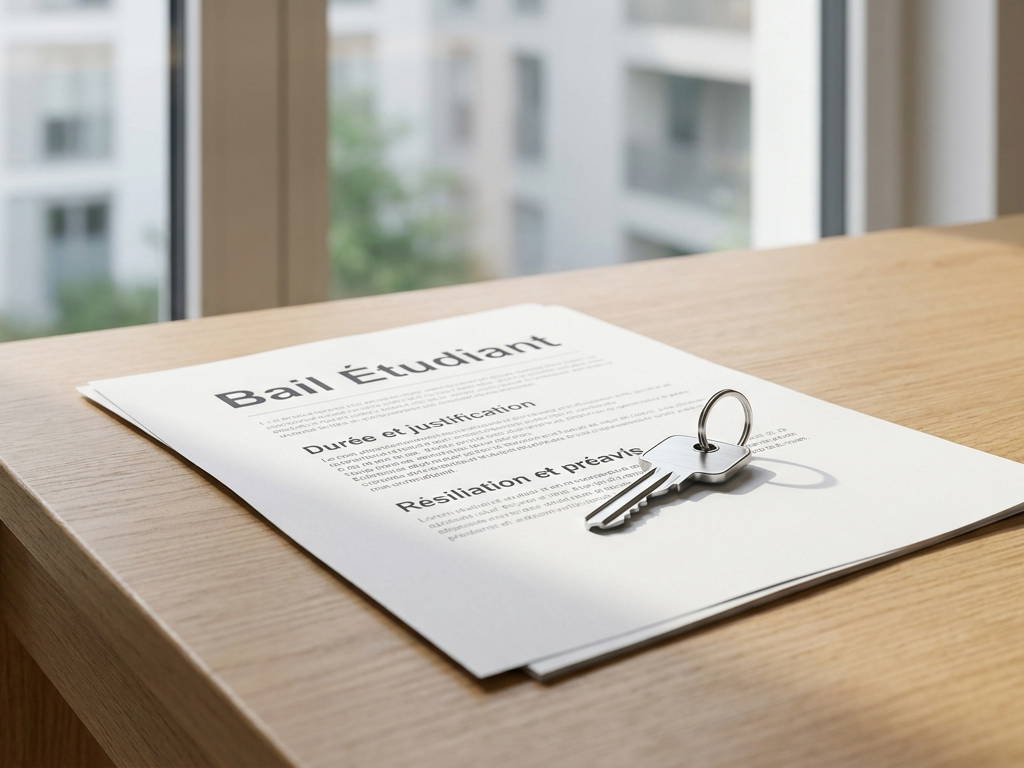
Another major feature of the 2026 Flanders student lease concerns its duration. The legislation clearly stipulates that the contract is concluded for a maximum duration of 12 months. It is perfectly possible to sign for a shorter duration, for example 10 months (the strict academic year), but it is impossible to exceed the one-year mark in a single contract.
Furthermore, Flemish law formally prohibits any tacit renewal. This means that at the end of the lease, it terminates automatically, without either party having to send a notice of termination. If the student wishes to stay in their room for the following year, they must sign a new contract with their landlord. This rule offers immense flexibility and prevents students from being stuck in accommodation if they decide to change cities or study paths.
Practical example: Marie rents a homestay room in Ghent via Roomlala from September 1, 2025, to August 31, 2026. Arriving in June 2026, she knows she wants to stay for her master's degree. She cannot simply continue paying her rent in September hoping that the lease will extend. She and her host must draft and sign a brand new student rental contract starting September 1, 2026, thus ensuring complete transparency for both parties.
Rent, charges, and security deposit: What changes for 2026
The financial aspect is often the main source of concern when it comes to renting a student room in Belgium. Flanders has therefore legislated very strictly to avoid abuse and guarantee total transparency regarding the actual costs of housing. No more unpleasant surprises at the end of the year with exorbitant and incomprehensible utility bills.
The Flemish legislator has imposed the principle of clarity: the student must know exactly how much their room will cost them each month upon signing the contract. This greatly facilitates student budget management and reassures parents who often act as guarantors.
Let's take a closer look at how rent, authorized charges, and the very strict rules governing the security deposit in Flanders are structured.
The principle of all-inclusive (or almost) rent
The golden rule in Flanders is that the rent agreed upon in the student lease contract must include absolutely all costs and charges related to occupying the room. This includes municipal taxes, maintenance costs for common areas, tenant liability insurance, or even the use of furniture. The landlord cannot under any circumstances claim supplements for these items during the year.
However, the law provides a strict exception for three types of charges that can be billed separately, provided this is explicitly mentioned in the lease: water, energy (electricity, gas, heating), and telecommunications (internet, television). These costs can be billed either as a fixed package (a fixed monthly amount that will not be adjusted) or as a provision (with an annual statement based on actual consumption).
Practical example: Emma rents a room in Antwerp for 450 euros per month. Her contract stipulates that this amount includes hallway cleaning and the trash tax. On the other hand, the contract mentions a provision of 60 euros per month for water, gas, electricity, and Wi-Fi. At the end of the year, the landlord must provide Emma with the actual bills to justify these 60 euros per month and proceed with a refund if she consumed less, or ask her for a supplement if she consumed more.
A strictly capped security deposit
The security deposit is another major point of vigilance. In Flanders, the law is uncompromising: the security deposit required by the landlord is strictly capped at 2 months' rent (excluding charges if these are billed separately). It is completely illegal to ask for a 3-month deposit for a student lease under the Huurdecreet regime.
Moreover, this sum must never be paid in cash or into the landlord's personal bank account. It must be placed in a blocked account in the student's name, which will accrue interest in their favor. At Roomlala, we constantly remind our users of the importance of following this legal procedure to avoid any disputes at the end of the stay.
Practical example: Thomas finds a great shared student housing in Flanders via our platform, with rent of 500 euros excluding charges. The landlord, Mr. Janssens, asks him for a security deposit. Thomas will have to lock a maximum of 1000 euros (2 x 500 euros) in a specific bank account. At the end of his lease, if no damage is found during the exit inventory, Mr. Janssens will sign the release document and Thomas will get his 1000 euros back, plus any interest generated by the bank.
Termination and cancellation of the 2026 Flanders student lease: What are your rights?
Student life is full of unforeseen events: reorientation, academic failure, family problems, or a simple change of plan. Flemish legislation has taken this reality into account by offering students legal and regulated exit doors, which are impossible in a standard lease. This is invaluable security for young tenants.
On the host side, these rules may seem restrictive, but they are offset by clear and strict notice periods that allow them to turn around and find a new tenant quickly. At Roomlala, we facilitate this transition thanks to our large community of students constantly searching for accommodation.
Let's discover the two main scenarios for early contract termination: cancellation before the academic year even begins, and termination during the year for specific reasons.
Cancellation before moving in
This is a very strong specific feature of Flemish law: the student has the right to cancel their lease even before it comes into effect, and without having to pay any compensation to the landlord. However, this right is subject to an extremely strict deadline condition: the student must notify the landlord at least 2 months before the scheduled start date of the contract.
The notification must be done officially, ideally by registered letter, to keep proof of the sending date. If this 2-month deadline is not respected (for example, a cancellation at the end of August for a lease starting September 1), the student will be liable for an indemnity equivalent to 2 months' rent.
Practical example: Chloé, a francophone student, signed a lease in May for a room in Hasselt starting September 1. In June, she learns that she has finally been accepted to a school in Brussels. She immediately sends a registered letter to her Flemish landlord on June 15 to cancel the lease. Since she respects the deadline of more than 2 months before September 1, her cancellation is free and legal. The landlord then has the whole summer to find a new tenant on Roomlala.
Terminating the contract during the year
Once the academic year has begun, the student cannot terminate their lease on a whim. Flemish law authorizes early contract termination during the year only in two dramatic or exceptional situations: if the student ends their studies (dropout, unenrollment from the institution), or in the event of the death of one of their parents (or the person providing for their maintenance).
In these specific cases, the student can terminate the contract with a 2-month notice period. The notice begins on the first day of the month following the sending of the registered letter. The student will, of course, have to provide proof of dropping out of studies or the death certificate to validate this early termination.
Practical example: Maxime realizes in November that his engineering studies at KU Leuven do not suit him at all. He decides to drop out and unenrolls from the university on November 15. He sends his notice by registered letter on November 18, attaching his unenrollment certificate. His 2-month notice will begin on December 1 and end on January 31. He will have to pay his rent until the end of January, at which point he will be definitively released from his obligations.
Subletting and student shared housing in Flanders: Best practices
International mobility is an integral part of modern university studies. More and more students go on Erasmus exchanges or do internships abroad during the year. What should you do with your room during this period? Flemish legislation has provided specific provisions for subletting, thus promoting flexibility.
Furthermore, faced with the rising cost of living, student shared housing in Flanders is a huge success. Sharing a large apartment or house between students allows them to reduce costs while enjoying a rich social life. But here too, rules apply.
At Roomlala, we encourage these collaborative lifestyles, provided they are carried out in compliance with the legal framework. Here is what you need to know to sublet or share a home legally.
The right to regulated subletting
In principle, subletting is prohibited without the landlord's consent. However, the Flemish Huurdecreet introduces a significant exception: subletting is legally authorized if the student tenant is leaving as part of an exchange program (like Erasmus) or an official internship. In this scenario, the landlord can only refuse the subletting if they have a just and legitimate reason.
The primary tenant remains responsible for paying the rent and any damage caused by the subtenant. It is therefore crucial to choose the person who will occupy the room carefully. Roomlala is the ideal platform to find a trusted subtenant for a few months, thanks to our verified profile system and community reviews.
Practical example: Sarah, a tenant of a room in Leuven, leaves for a 4-month internship in Berlin from February to May. She informs her landlord in writing of her subletting project by presenting the file of Hans, a German student who is just coming to do an Erasmus exchange in Leuven for the second semester. The landlord accepts. Sarah drafts a subletting contract with Hans. Hans pays the rent to Sarah, who continues to pay her landlord. Everyone wins!
Renting a student room in Belgium: The choice of shared housing
Shared housing is an excellent alternative to an individual room. In Flanders, several students can sign a joint lease to rent a house or a large apartment. In this case, the student lease rules apply if all housemates prove their student status. A solidarity clause is often inserted into the contract, meaning that if one housemate does not pay their share, the landlord can claim the full rent from the others.
Another option, very popular on Roomlala, is renting individual rooms in a homestay. The host lives in the house and rents one or more rooms to students. Each student then signs an individual student lease for their room, with access to common areas. It is a reassuring, economical formula governed by the same rules for deposit capping and a maximum duration of 12 months.
Practical example: Mr. and Mrs. Peeters live in a large house near the Ghent campus. Their children having left, they decide to rent three empty rooms via Roomlala. They sign three separate student leases with Julien, Clara, and Ahmed. Each contract lasts 10 months, includes a fixed rent covering cleaning and internet, and includes a provision for heating. The three students live in shared housing in the hosts' home, in a perfectly respected and secure legal framework.
In conclusion, the legislation on student rooms in Flanders is designed to balance the rights of students and those of landlords. By mastering the rules of the Flemish student lease for the start of the 2026 academic year (strict duration, capped deposit, cancellation, and subletting conditions), you ensure a serene rental experience. Whether you are looking to rent your first student room or want to host a student in your home, Roomlala is your trusted partner to facilitate your procedures and secure your rentals in Belgium.


There are no comments yet.
Leave a comment
You must be logged in to post a comment.