
 SEARCH
 LIST YOUR PROPERTY
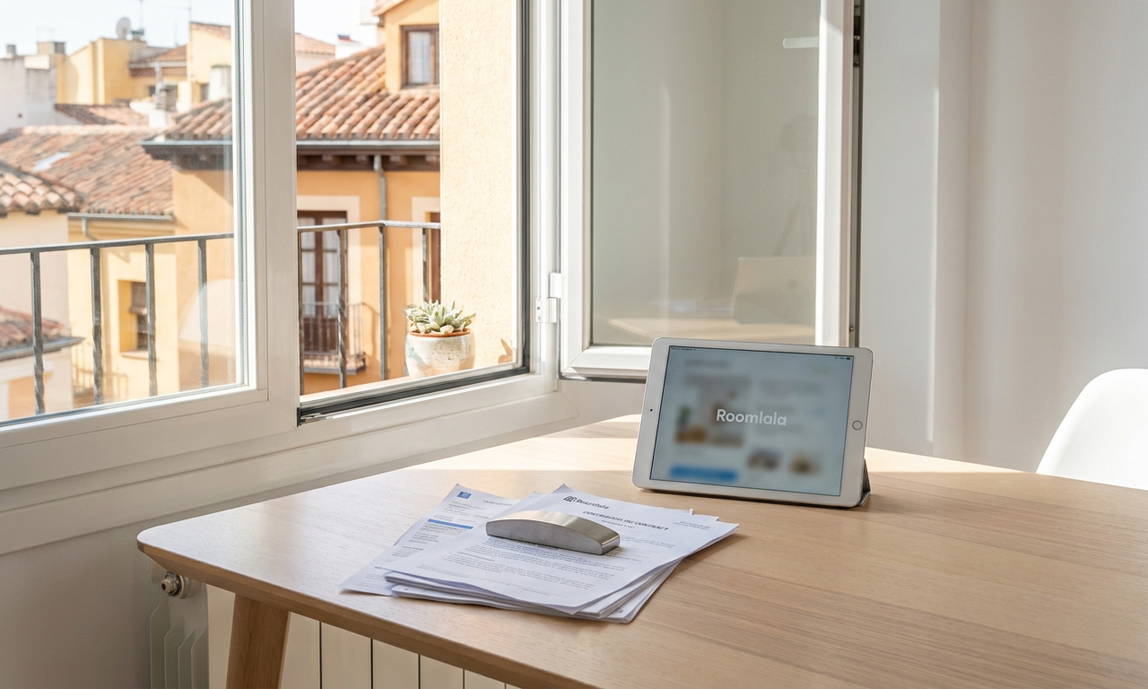
Are you a host in Spain with a spare room in your primary residence? With the rising cost of living and inflation, renting to a student or young professional is a great way to generate a steady, secure secondary income. However, when tax season arrives, many hosts face complex questions. Good news: tax legislation has recently evolved in favor of hosts. In this comprehensive article, we will walk you through everything you need to know about the 2026 IRPF tax on room rentals, the new applicable rules, and tips to legally optimize your taxes. At Roomlala, we support thousands of hosts every day through this administrative and personal process, so follow our expert guide to understand it all!
2026 IRPF room rental: New tax rules in Spain
Income classification: rendimientos del capital inmobiliario
In Spain, real estate taxation is strictly regulated by the Agencia Tributaria. For many years, renting a single room, rather than an entire home, was the subject of complex legal debates regarding applicable tax benefits. Today, the situation is perfectly clear for reporting income for the current year. All income generated from renting a room in your own home must be declared under the IRPF under the specific category of real estate capital gains (rendimientos del capital inmobiliario).
Read also: Increase in the residential surtax in 2026: Rent out a room for the long term to make your home profitable, Cedolare Secca 2026: The tax benefits of renting out a student room in Italy and New CIN regulations in Italy: Why hosts are turning to shared housing in 2026
It is absolutely crucial not to confuse this standard rental income with income from business activities, otherwise, you risk losing your eligibility for valuable tax deductions. To keep your rental in this advantageous category, you must not provide any hotel-like services to your tenant. This means, specifically, no breakfast included, no daily cleaning service in the rented room, and no regular changing of bed linens by you. Furthermore, you must not employ anyone specifically dedicated to managing this rental activity.
The exceptional 50% deduction: A win for hosts
The major update positively impacting the 2026 IRPF room rental rules comes from a highly anticipated shift by the Spanish General Directorate of Taxes (DGT). Thanks to binding consultations V0412-25 from March 2025 and V2457-25 from December 2025, it is now officially and legally confirmed that room-by-room renting entitles you to the famous 50% reduction on net income for IRPF purposes.
This institutional decision is a major win for Spanish hosts and Roomlala hosts. In practical terms, this means that on the net profit from your rental—your gross income minus all your deductible expenses—only half (50%) will actually be subject to income tax. It is an extremely powerful financial tool to monetize your available space while significantly limiting your annual tax burden.
What are the deductible expenses to reduce your taxes?
Expenses eligible for tax deduction
To calculate the net income to which the 50% deduction will apply, you must first subtract your legitimate expenses from your gross income. Fortunately, taxation for homestays in Spain allows you to deduct a multitude of common costs related to property ownership, maintenance, and the daily use of the home. This is a fundamental step for optimizing your tax return.
Among the most common deductible expenses, the IBI (Impuesto sobre Bienes Inmuebles) is a primary one, as it often represents a significant budget. You can also deduct homeowners' association fees (comunidad de propietarios), comprehensive home insurance premiums, and interest on your mortgage if you are still paying off your primary residence. Depreciation of the property, generally calculated at 3% of the construction value (excluding land value), is also a very powerful accounting deduction that is often forgotten by new hosts.
Daily energy bills such as electricity, water, gas, and even your internet subscription are also deductible, strictly provided that they are included in the rent paid by the tenant and paid for by you to the suppliers. This is an essential point for hosts on our Roomlala platform, who very often offer all-inclusive rooms to simplify the budget and lives of student tenants or young professionals.
How to calculate the proportionality rule without errors?
Please note that these tax deductions clearly do not apply to the total expenses of the house, but only to the specific portion being rented. This is where the proportionality rule comes in, which is closely monitored by Spanish tax inspectors. The calculation of deductible expenses must be strictly proportional to the rented surface area and the actual time of rental.
Let’s look at a concrete example to illustrate this mechanism. Imagine you own a beautiful 100-square-meter apartment in the heart of Valencia. You rent a 15-square-meter room exclusively to a university student, and you share 30 square meters of common areas (the living room, equipped kitchen, and bathroom) with them. The total surface area attributed to the rental is calculated as follows: the 15 private square meters of the room plus half of the shared spaces (i.e., 15 square meters), which gives a weighted total of 30 square meters.
In this specific use case, you are entitled to deduct exactly 30% of your annual electricity bills, 30% of your IBI, and 30% of your mortgage interest. If the room was only rented for 9 months of the year (for example, for the duration of a school year), you must apply a second temporal pro-rata (9 divided by 12) to this initial 30%. This mathematical rigor is essential for declaring room rental income in Spain with peace of mind and avoiding any unpleasant surprises.
Strict conditions to benefit from the homestay tax regime in Spain
While the exceptional 50% deduction is particularly attractive for your wallet, it is not granted automatically by the administration. The Agencia Tributaria sets very strict eligibility conditions to prevent abuse, especially given the uncontrolled proliferation of tourist rentals in large Spanish cities.
The prerequisite, the pillar of this reduction, is that the rented room must be the habitual and permanent residence of your tenant. The political and social goal of the Spanish state through this measure is to promote long-term housing access for citizens, not to indirectly subsidize clandestine hospitality or mass tourism.
Therefore, tourist rentals, very short-term weekend rentals via vacation platforms, or purely seasonal summer rentals are strictly and permanently excluded from this 50% reduction. If you decide to rent your room for a few days or weeks to passing vacationers, you will have to pay IRPF on 100% of your net income, with no possible deduction.
For the specific case of students, the situation can sometimes seem ambiguous to hosts because these young people often return to their parents' homes during the summer period. However, case law and tax authorities tolerate this situation: a contract covering the full academic year (generally from September to June) is accepted if the student has their center of interest and main activity there during this long period. It is therefore absolutely crucial to properly categorize the nature of the rental when drafting your listing on Roomlala to attract the right profiles.
Declaring room rental income in Spain: Our tips for avoiding tax audits
During the annual income tax campaign, the utmost caution is required. Regarding room rental taxes, you must be aware that the burden of proof always lies with the declaring host. In the event of a random tax audit, it is up to you, and you alone, to demonstrate irrefutably that all legal conditions were met to benefit from the 50% deduction.
To prove that the room is indeed the primary residence of your tenant, you must build a solid file. Here are the essential elements to gather:
- An explicit lease agreement: Draft a contract for a term of at least one year (or a full academic year), mentioning very clearly the use as a habitual and permanent residence.
- The empadronamiento certificate: This is the key document. You must strongly encourage your tenant to register at the town hall (padrón municipal) at your exact address. This is the ultimate administrative proof that they live with you on a daily basis.
- Clear bank records: Require rent payment by monthly bank transfer, with a clear reference, to prove the regularity and reality of the transaction.
Finally, make it a habit to carefully keep all your energy bills, bank amortization tables, insurance receipts, and proof of transfers from your tenants for at least four years. A well-organized administrative file is your best and only shield against a tax audit. Never forget that the Agencia Tributaria is cross-referencing more and more digital data, particularly through the tax returns of the tenants themselves who may apply for housing assistance or regional deductions. Consistency between your two declarations must be perfect.
Why choose Roomlala to rent your room legally?
Renting a room in your home is a particularly enriching human experience and is financially very relevant, especially when you master the benefits of the 2026 IRPF room rental rules. But to enjoy it with complete peace of mind, you need to be well-supported and use the right tools. That is exactly where we come in to make your life easier.
At Roomlala, we make it a point of honor to secure all your rental processes. Our specialized platform connects you exclusively with carefully verified profiles, whether they are serious students, interns, or young professionals looking for stable, long-term housing. This type of tenant perfectly matches the strict criteria required by the Spanish tax administration to justify habitual residence and unlock your tax benefits.
Furthermore, our highly secure online booking and payment system guarantees you a reliable and indelible digital record of all your income received. This greatly facilitates your accounting work at the fateful moment of declaring your Spanish room rental income. You avoid cash payments, which are not only limited by law for rent payments but are also completely indefensible in the event of an in-depth tax audit.
By joining the large community of Roomlala hosts, you benefit from a framework of absolute trust. You keep total control: you can set your own house rules, choose the rental duration that suits you best (while respecting tax criteria if you are aiming for the 50% deduction), and generate a perfectly legal, secure, and very lightly taxed secondary income. Don't wait another second; post your listing for free today on Roomlala and start optimizing your available space in the best way possible!







There are no comments yet.
Leave a comment
You must be logged in to post a comment.