
 SEARCH
 LIST YOUR PROPERTY
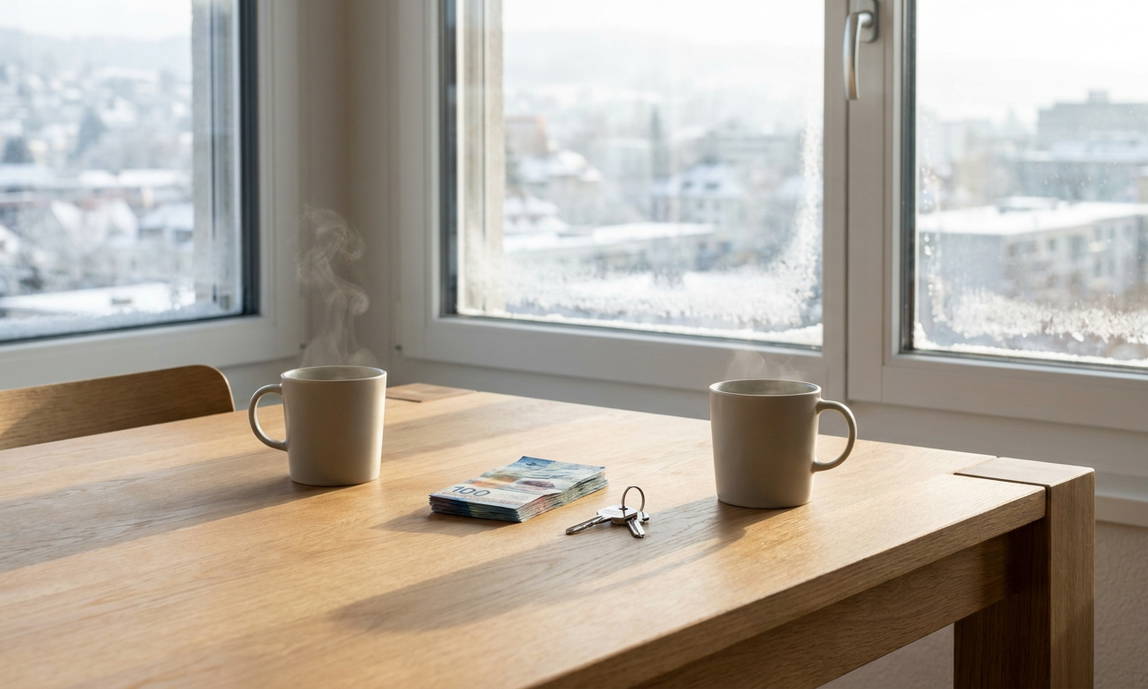
Winter 2026 is at our door, and with it, a major concern for many households: paying energy bills. While snowy landscapes give our country its charm, the cost of heating our interiors has become a real financial headache. Faced with bills that continue to weigh on purchasing power, more and more tenants are looking for long-term solutions. At Roomlala, we see a strong and practical trend: taking in a roommate or a student to share costs. But how do you go about it in practice? Discover why partial subletting is emerging as the best strategy for dealing with Swiss rental charges 2026, all while optimizing your home's space in full compliance with the law.
Understanding Swiss rental charges 2026: Why are bills still so high?
To properly grasp this winter's situation, it is crucial to look at the figures and the legislation. Although we have passed the peak of the global energy crisis, energy prices in Switzerland have stabilized at a high plateau, directly impacting the summary of charges you receive from your property management company.
Read also: New subletting rules in Switzerland: How to legally rent out a room in 2026, Subletting in Switzerland in 2026: The real rules for renting out your room and Ontario Rent Increase 2026: Why Renting Out a Room Appeals to Hosts
The impact of the rise in heating and electricity in Switzerland
According to the latest data published by ElCom (Federal Electricity Commission), the median price of electricity in Switzerland for 2026 is 27.7 cents per kilowatt-hour (kWh). At first glance, one might be pleased with a slight 4% decrease compared to 2025. However, the reality is more nuanced: this rate remains 32% higher than the levels we experienced before the energy crisis. This stagnation at a high level means that the Swiss heating price hike continues to be felt heavily on household budgets.
In concrete terms, an average family apartment that was paying monthly charge installments of 150 CHF a few years ago must now often pay more than 200 CHF, without any guarantee of avoiding a steep back-payment in the spring. Winter 2026, with its forecasts of harsh temperatures, will only increase this pressure on radiators and, consequently, on wallets.
What does Article 257a of the Swiss Code of Obligations say?
It is important to understand what your landlord is allowed to charge you. In Switzerland, Article 257a of the Code of Obligations strictly regulates ancillary costs. Heating costs, hot water production, and electricity for common areas (such as the elevator or stairwell) constitute the rental charges that can be directly passed on to the tenant. The landlord cannot invent new charges, but they do pass on the actual energy costs they pay to suppliers.
Let's take a concrete example: Sarah, a tenant in a 4.5-room apartment in Lausanne, saw her annual summary of charges increase by 800 CHF in two years, mainly due to the cost of gas and electricity. Since her salary has not kept up with this inflation, she finds herself having to dip into her savings. It is precisely in this type of situation that subletting an unoccupied room makes perfect sense to absorb the shock.
Subletting a room in Switzerland: A legal and effective response for your budget
Faced with this inflation of housing-related costs, leaving a room empty in your apartment has become a luxury that many no longer want to afford. Fortunately, Swiss law is on the side of tenants who wish to optimize their space for economic reasons.
The inalienable right to sublet (Article 262)
Subletting a room in Switzerland is a fundamental right guaranteed by Article 262 of the Code of Obligations. At Roomlala, we want to reassure our community: this right is firmly established. Moreover, the recent draft revision of the tenancy law, which aimed to drastically restrict subletting conditions, was definitively rejected by popular vote at the end of 2024. Swiss citizens thus reaffirmed the importance of this rental flexibility.
This means that in 2026, you still have the absolute right to sublet a part of your accommodation, whether to host a student from EPFL or UNIGE, a young professional, or a cross-border worker. This practice is part of a logic of mutual aid and rationalization of urban space, particularly in cantons where there is a housing shortage (such as Geneva, Vaud, or Zurich).
Budget roommate: Sharing costs without losing comfort
Adopting a budget roommate strategy is extremely powerful. By renting out a room, you don't just receive rent that helps pay the main rent; you also split those famous rental charges. Hot water, electricity, internet subscription, and the Serafe fee can be shared equitably.
Imagine the case of Marc, a young retiree living alone in a large apartment in Geneva since his children moved out. Faced with winter charges, he decided to rent a room in a homestay via Roomlala. He is now hosting Thomas, a master's student. Thomas pays a monthly rent of 650 CHF, charges included. For Marc, it's a vital income that fully covers the increase in his energy bills and even leaves him with extra income for his leisure activities, while providing him with pleasant daily company.
How to rent a room in a home legally in Switzerland?
While the law authorizes you to sublet, it nevertheless imposes strict rules that must be respected to avoid any conflict with your landlord or property management. At Roomlala, we support you so that this process is done with the utmost peace of mind.
Obtaining the agreement of the management or landlord
This is the golden rule: the main tenant must obtain the consent of their landlord to sublet part of their home. This request for authorization must be made in writing and, a crucial point of vigilance, it must be sent before the start of the sublet. Subletting in secret exposes you to a major risk: the extraordinary termination of your main lease for breach of trust.
Rest assured, the landlord cannot refuse your request arbitrarily. The law limits their refusal to three strict grounds: if you refuse to provide them with the conditions of the sublet (identity of the subtenant, duration, amount of rent), if the sublet presents major disadvantages for them (for example, if you sublet to a band of musicians who rehearse at night), or finally, if you are making an abusive profit.
Setting a fair and proportional rent
This last point is arguably the most important. In Switzerland, subletting is not a business designed to make you rich at the expense of the owner, but a solution for sharing costs. The rent requested from your subtenant must be strictly proportional to the surface area rented and the associated charges.
Here is an example calculation of a use case: You rent a 100 m² apartment for 2000 CHF per month, charges included. You want to sublet a 15 m² room. The subtenant will also have access to the common areas (kitchen, living room, bathroom), which represent 45 m². It is generally estimated that the subtenant uses half of the common spaces (22.5 m²). Their usage area is therefore approximately 37.5 m², or 37.5% of the apartment. The maximum rent you can ask them for is therefore around 750 CHF (37.5% of 2000 CHF), plus a small margin (generally 10 to 20% maximum) if the room is rented furnished. If you ask for 1200 CHF for this room, the property management will refuse your request due to abusive profit.
The essential precautions for serene cohabitation
Welcoming someone into your home is an enriching human adventure, but it requires a minimum of legal and practical framework. The main tenant (you) remains solely responsible to the landlord. If your subtenant does not pay their share or causes damage in the apartment, the property management will turn to you.
It is therefore absolutely necessary to draw up a written sublease agreement. This document will specify the duration of the lease, the amount of rent and charges, the notice period (usually one to three months), as well as the rules of living together. At Roomlala, we provide our members with contract templates that comply with Swiss law to facilitate this step.
In addition, always require that your subtenant has private liability insurance (RC) valid in Switzerland. This is what will intervene if they accidentally damage the parquet floor of their room or the kitchen equipment. Finally, set clear rules from the start regarding the use of heating: remind them that a temperature of 20°C is sufficient in living areas and that it is useless to heat the room to 25°C with the window open. Communication is the key to a successful budget roommate arrangement.
Why take the leap with Roomlala this winter?
Winter 2026 promises to be demanding in terms of budget. The Swiss rental charges 2026, driven by still-high electricity prices, require finding intelligent solutions. Rather than suffering these increases, regaining control of your budget by leveraging the unused space in your home is a modern, ecological, and supportive approach.
Our platform Roomlala is designed to connect you with verified and serious profiles, whether they are students, interns, or professionals on the move. We secure online payments, which guarantees you will receive your rent without delay, and we offer you a framework of trust to communicate with your future subtenants before making your decision.
Don't let rising heating costs sink your finances this year. Take the lead, inform your property management, set a fair rent, and join the community of Swiss hosts who have made the smart choice of subletting. It is together, by sharing our living spaces, that we will get through the winter warm, all while keeping peace of mind.

There are no comments yet.
Leave a comment
You must be logged in to post a comment.