
 SEARCH
 LIST YOUR PROPERTY
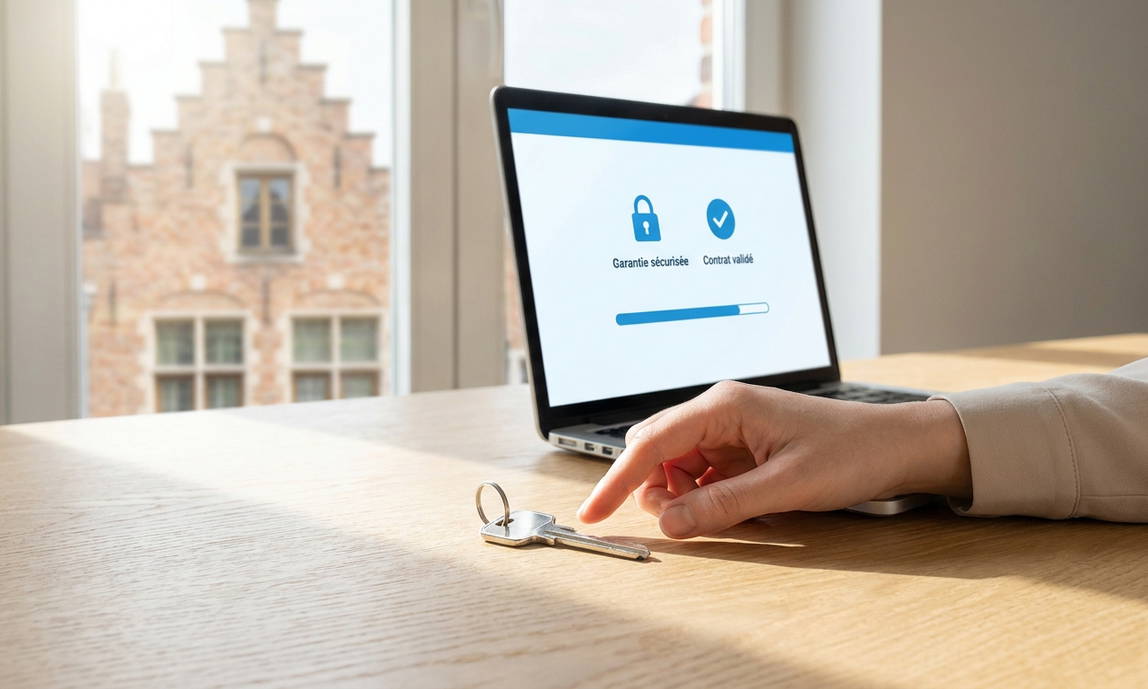
Settling into a new Flemish city is an exciting adventure, but the administrative procedures can sometimes seem complex, especially when it comes to securing your accommodation. At Roomlala, we know that the issue of the security deposit is often a source of stress for both tenants and hosts. In 2026, legislation continued to evolve to offer an increasingly protective and transparent framework. Whether you are looking to join a lively shared housing setup in Ghent or rent a peaceful homestay in Antwerp, it is essential to master the rules governing the Flanders rental guarantee 2026. This comprehensive guide aims to decipher for you the legal modalities, current ceilings, secure blocking methods, and everyone's rights. We accompany you step by step so that your long-term rental experience proceeds with peace of mind, in strict compliance with the Flemish Residential Tenancy Decree (Vlaams Woninghuurdecreet).
Understanding the Flanders 2026 rental guarantee ceilings
The primary residence lease: the strict 3-month rule
Within the framework of a standard long-term lease, where the tenant establishes their primary residence in the property, the Flemish legislature has set very clear limits to avoid abuse. In 2026, the legal ceiling for the rental guarantee is strictly limited to a maximum of three months' rent. This measure aims to protect tenants against excessive financial demands while offering reasonable coverage to hosts in the event of rental damage or unpaid rent.
Read also: 2026 Housing Act: What changes for room rentals in Spain, Local Accommodation 2026: Why prioritize long-term rentals in Portugal and 2026 Property Tax: How renting out a homestay can lower your bill
It is crucial to note that this calculation is based exclusively on the base rent, meaning excluding common charges or fixed fees for energy. For example, if you rent a spacious room with a rent of 500 euros and 75 euros in monthly charges, the host cannot demand a maximum amount of 1500 euros for the deposit, not 1725 euros. Any contractual clause requiring a higher amount is considered null and void by the competent peace courts in Flanders.
At Roomlala, we ensure that the listings published on our platform comply with these legal ceilings. We always advise our users to read their lease agreement carefully before signing. If a host asks you for a guarantee equivalent to four or five months' rent for a primary residence, you have the right to refuse and rely on the Vlaams Woninghuurdecreet to demand the regularization of the situation.
Let's take a concrete use case: Marc, a young professional, finds a homestay in Leuven for a three-year lease. The rent is 600 euros. The host asks him for 1800 euros as a guarantee. Marc knows this is the legal maximum. He accepts, but ensures that the money will not be handed over directly, a point we will discuss in detail in the following section.
The student lease (kot): the specific 2-month limit
Flanders attracts tens of thousands of students every year, and the "kot" market is particularly dynamic. For this segment, which is often more financially vulnerable, the legislation has provided an important derogation. If you sign a specific student lease agreement, the rental guarantee is capped at a maximum of two months' rent, not three.
This distinction is fundamental. It is essential to correctly qualify the type of lease right from the start. A student lease generally implies that the tenant proves their status (via a university enrollment certificate) and does not domicile their primary residence at this address, unless explicitly agreed otherwise. This maximum two-month protection helps reduce the barrier to entry for young people who often have to pay significant expenses at the start of the school year.
Imagine Sophie, a French student coming to do her Erasmus in Ghent. She finds a superb kot at 450 euros per month. Her host can legally only ask her for a 900-euro guarantee. If the host attempts to pass the contract off as a primary residence lease in order to demand three months' deposit, Sophie can challenge this practice, as her student status takes precedence in the qualification of the contract.
We recommend that Roomlala hosts who specifically target students familiarize themselves with these standard contracts. Proposing a proper student lease, with a two-month deposit, reassures tenants and their parents, speeds up the rental process, and guarantees total compliance with Flemish authorities.
How to legally lock your deposit in Flanders?
Authorized and secure blocking methods
A golden rule we constantly remind our users of at Roomlala: the payment of the deposit in cash or directly into the host's personal bank account is completely illegal in Belgium, and particularly monitored in Flanders. The funds must imperatively be protected and isolated from the host's assets. The most classic method remains the blocked bank account in the tenant's name.
To open this blocked account, the tenant and the host must sign a specific document at the bank. The funds are deposited there and generate interest that rightfully belongs to the tenant (capitalized annually). The money can only be released at the end of the lease with the dual signature of both parties, proving that an agreement has been reached following the inventory check.
However, in 2026, the most recommended and simplest method is the use of the public e-DEPO platform, managed by the FPS Finance (Deposit and Consignment Office). This free service, accessible online via Itsme or an electronic identity card, allows you to deposit the Flanders 2026 rental guarantee in a few clicks. It is an extremely secure solution that avoids the bank fees sometimes applied by certain private institutions.
Here is an example of the procedure to follow: Thomas is about to rent a room. He connects to e-DEPO, creates a new rental guarantee file by indicating the contact details of his future host and the lease data. He makes a transfer to the Belgian State's account. The host then receives an official notification confirming that the funds are secured. At the end of the lease, the request for release will be done just as easily via the same digital interface.
Financial assistance to build your guarantee
Building a guarantee equivalent to two or three months' rent can represent a major financial obstacle, especially during a move that already incurs many costs. Fortunately, the Flemish Region has implemented support mechanisms for tenants in difficulty. The most well-known is the zero-interest loan granted by the Vlaams Woningfonds (Flemish Housing Fund).
This loan allows tenants who meet certain income conditions to borrow the exact amount of the rental guarantee, without any interest. The funds are paid directly to a blocked account, and the tenant repays the Vlaams Woningfonds in small monthly installments over a period of up to 24 months. It is a breath of fresh air for young workers or single-parent families.
Furthermore, the Public Centres for Social Welfare (CPAS / OCMW in Flanders) can also intervene. If the tenant does not meet the conditions of the Vlaams Woningfonds but is in need, the CPAS can provide a bank guarantee letter to the host or advance the funds. The host is thus assured of being covered, while the tenant avoids ending up on the street for lack of liquidity.
At Roomlala, we encourage hosts to be open to these devices. Accepting a deposit constituted via the Vlaams Woningfonds or the CPAS in no way diminishes your financial security. On the contrary, it demonstrates the serious support of the tenant by public institutions. For example, if you rent a room to a young apprentice supported by the CPAS, you benefit from a solid institutional guarantee while participating in a positive social endeavor.
Shared housing and homestay lease in Flanders: what are the specificities?
The joint lease agreement (samenhuur) and the solidarity clause
Shared housing, or 'samenhuur' in Flanders, is increasingly successful. But from a legal perspective, the management of the Belgium shared housing deposit fundamentally depends on the contract structure. If all tenants sign one single lease agreement with the host, it is referred to as a joint lease. In this case, the tenants are generally bound by a solidarity clause.
This solidarity means that the host considers the group as a single entity. The rental guarantee is therefore global. The three-month ceiling applies to the total rent of the house or apartment. The tenants must arrange among themselves to gather the sum, which they will pay into a joint blocked account (often opened in the name of two representatives of the group) or via e-DEPO.
The major point of caution here is that the host can turn against any tenant for the payment of the full rent or for damages, even if the fault lies with only one member. The global guarantee serves to cover all potential breaches. It is therefore essential that tenants draw up a shared housing pact among themselves to define internal responsibilities and the distribution of the deposit.
Imagine a house rented by four friends in Bruges. The total rent is 1200 euros. The maximum guarantee is 3600 euros. Each friend contributes 900 euros. They open a joint blocked account. If one of the friends seriously damages the living room and the repairs cost 1500 euros, the host will deduct this sum from the global guarantee at the end of the lease. It will then be up to the friends to arrange for the responsible party to reimburse the others. This is why we recommend choosing your housemates with care!
Individual contracts for homestay rentals
Unlike the joint lease, the homestay lease in Flanders very often takes the form of individual rental contracts. In this model, very popular on Roomlala, the host signs a separate contract with each tenant for their private room and access to common areas (kitchen, bathroom).
The great strength of this system is the legal and financial independence it offers. The rental guarantee is specific to each tenant. The three-month ceiling is calculated only on the rent of the room being leased. There is no financial solidarity between the different tenants of the house. If the tenant of room A does not pay their rent, the host cannot under any circumstances touch the deposit of the tenant of room B.
This method greatly simplifies the management of arrivals and departures. When a tenant leaves their room, they conduct their own inventory check at exit with the host. If everything is in order, their personal guarantee is returned to them independently of the presence of the other tenants in the house. This is the format we favor at Roomlala for hosts offering multiple rooms in their primary residence.
Take the example of Martine, who rents three rooms in her large house in Hasselt. She has signed three individual leases. Each tenant has locked their own guarantee on e-DEPO. When Lucas, one of the tenants, decides to leave after two years, Martine only checks Lucas's room and the general state of the common areas. She validates the release of Lucas's deposit on e-DEPO without disrupting the contracts of her two other tenants.
Tenant departure and release of the Belgium shared housing deposit
The standard fund release procedure
The end of the lease marks the long-awaited (or dreaded) moment of the release of the rental guarantee. The legal procedure requires that an inventory check at exit be carried out in a contradictory manner, that is to say in the presence of the tenant and the host. This document is then compared with the entry inventory check. If no damage (excluding normal wear and tear) is noted and all rent and charges have been paid, the guarantee must be released in its entirety.
In Flanders, there is no strict legal deadline set to the exact day for restitution, but the law stipulates that it must be done within a reasonable time (generally estimated at 1 or 2 months maximum by case law) after the return of the keys. If the funds are in a blocked account or on e-DEPO, both parties must sign the release form. In the event of a disagreement on the amount of damage, only the uncontested part of the guarantee can be released immediately, with the remainder being blocked until the dispute is resolved, either amicably or through the peace court.
We strongly advise our users to prepare for this inventory check at exit. Tenants, clean the room from top to bottom and fill any holes in the walls. Hosts, bring the charge invoices to finalize the settlement quickly. Transparency and good faith are the keys to a quick refund.
If the host refuses to sign the release without a valid reason, the tenant can serve them with a formal notice via registered mail. If the blockage persists, a free conciliation before the peace judge is the first step before potential litigation proceedings. At Roomlala, we find that the majority of rental ends fortunately go smoothly thanks to good prior communication.
The specific case of the departing housemate and their replacement
The situation becomes more technical when a single member of a shared housing arrangement (under a joint lease) decides to leave the accommodation before the others. According to the Flemish decree, this departing tenant benefits from a two-month notice period. However, since the rental guarantee is global and joint, the bank or e-DEPO cannot simply release a quarter or a third of the total sum upon simple request.
For the departing tenant to recover their share of the deposit, the unanimous agreement of all parties is required: the host, the remaining tenants, and the departing tenant. The most common and safest method is to find a replacement. Upon signing the amendment to the lease agreement, the new tenant pays the equivalent of the deposit share directly to the departing tenant. On paper, the names are changed, but the funds locked at the bank remain intact and continue to guarantee the global lease.
It is imperative to conduct an intermediate inventory check (often limited to the departing person's room and a visual check of the common areas) to ensure that the newcomer will not be held responsible for previous damage. Without this intermediate inventory check, the new tenant risks having to pay for damage caused before their arrival at the time of the final release of the deposit.
Let's take one last example: Clara leaves her shared housing in Mechelen. She had contributed 800 euros to the common guarantee pot. Julien replaces her. After an intermediate inventory check validating that Clara's room is in perfect condition, Julien transfers 800 euros to Clara's personal account. An amendment is signed with the host. The house's global deposit, blocked at the bank, remains unchanged, but it now legally belongs in part to Julien. It is a fluid mechanic provided that you are rigorous with written documents.



There are no comments yet.
Leave a comment
You must be logged in to post a comment.